
Trace Jones County Former Owners by Transfer
The trail runs backward from the latest known transfer. A history of Jones County former owners starts there. The current assessor card supplies a parcel ID and a legal-description lead, while the Clerk of Superior Court's recorded deeds establish the conveyance trail. Four sources cover different periods and answer different questions.
| Source | Years It Covers | Where Held | What It Shows |
|---|---|---|---|
| GSCCCA real-estate index | January 1, 1980 forward | Online and Clerk | Parties, instrument type, date, and book/page |
| Clerk deed books and indexes | Earlier county record era | Superior Court Clerk deed room | Recorded transfers before the online marker |
| GSCCCA plat index | January 1, 1963 forward | Online and Clerk | Subdivision, lot, block, section, and survey references |
| Tax digests and archival collections | Historic, collection-dependent | Georgia Archives, UGA, and local library | Year-by-year clues that must be tied back to deeds |
Recent transfers start at the GSCCCA Real Estate Search. Find the newest deed there. When a chain reaches the 1980 boundary, contact the Jones County Clerk Real Estate Division. Do this before assuming an older instrument is missing. Tax digests can bridge date gaps. But they record a tax-year association rather than legal title.
Start Jones County Previous Owners With the Grantee
The newest recorded deed names the receiving party as grantee and the transferring party as grantor. Search the current owner in the grantee field. Limit the county to Jones. Compare the legal description against the parcel card, then treat that deed's grantor as the next name to research.
| Transfer date | Grantor to grantee | Deed type | Reference to retain |
|---|---|---|---|
| Newest verified filing | Prior owner to current grantee | Warranty, quitclaim, estate, or other deed | Book/page and legal description |
| Earlier acquisition | Earlier owner to later grantor | Instrument shown by index | Book/page, land lot, district, or plat |
| Pre-index step | Name sequence from local index | Deed-book entry | Original citation and spelling |
Treat any timeline as a worksheet, not a conclusion. Life estates, survivorship terms, multiple grantees, corrective deeds, and name changes can all create branches that demand separate checks.
Jones County Former Owners in Grantor and Grantee Fields
The GSCCCA name form offers real control. Filters narrow the index fast. No filter can pretend that a name alone identifies a parcel, so pair every result with the legal description. Log the query and the access date for each useful hit.
| Field | How to use it for former owners |
|---|---|
| Party Type | Choose Grantee to find when a past owner acquired the tract; use Grantor for the later transfer. |
| Instrument Type | Check warranty, quitclaim, gift, estate, trustee, sheriff, tax-sale, and foreclosure deeds as facts require. |
| County | Select Jones County and decide separately whether neighboring counties belong in the search. |
| Name and dates | Try initials, name variants, estates, trusts, and entities within a reasoned date range. |
| Display | Choose 5 to 100 results and a regular or one-line table view. |
The index carries a warning. Reconstructed entries and images may be incomplete or inaccurate. Whenever a web result conflicts, the Clerk's official index and recorded image control. The GSCCCA name-search screen displays the Jones County party, instrument, date, and display controls used for this work.
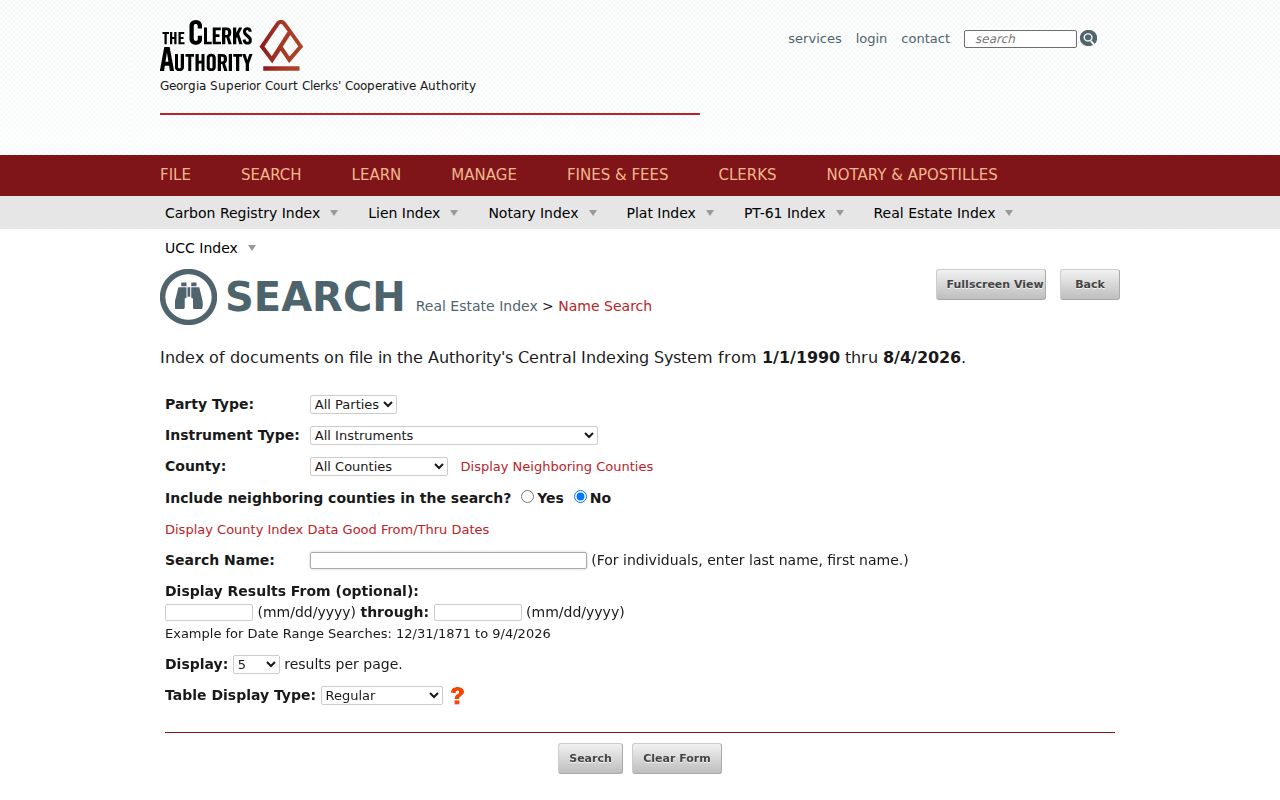
The party-type control makes the pivot simple. One deed shows the name as grantor. The earlier acquisition shows the same person as grantee. Note: A shared surname links two deeds only when the legal description and the transfer sequence also match.
Read Jones County Former Owners in Reverse
Build a reverse chain one verified transfer at a time. The pace is slower than reading a sales list, but it keeps similarly named people and unrelated parcels from blurring together.
- Use the assessor parcel ID and legal description to locate the newest deed.
- Read the deed's grantor, grantee, book/page, land lot, district, subdivision, and plat reference.
- Search that grantor as a grantee in an earlier date range.
- Compare the property description, then repeat until the online coverage marker is reached.
- Continue through the Clerk's older indexes and books when the chain predates the web table.
- Grantor and grantee
- The transferring party and receiving party named in a deed.
- Chain of title
- The ordered set of instruments through which an interest passed.
- Reverse index
- An index arranged to help find a deed through the receiving party.
- Quitclaim and warranty deed
- Different conveyance forms whose names do not, by themselves, prove the quality of title.
For the mechanics of retrieving a single instrument, see the Jones County deed records guide. The wider task on this topic is reconstructing former owners across time.
Jones County Former Owners Through Book and Page Clues
Old street addresses fail where citations succeed. Jones County legal notices pair modern locations with subdivision, plat, deed, and parcel references. Graystone Ridge at 465 Chapman Road offers a good example. The notice describes it as Lot 39, Block A, Section 1, Plat Book 8 page 95, parcel J59A 00 080, with a tax deed in Deed Book 1122 page 144. Canes Crossing Phase 1 carries Plat Book 20 pages 3 through 4 and Deed Book 725 pages 346 through 347. Northfork Estates uses Plat Book 6 page 14, while a related older security deed appears at Book 197 page 663. These citations work as search keys. They are not proof of every later transfer.
The GSCCCA Book/Page Search asks for county, book, and page. It may normalize the values you enter. Keep the citation exactly as first found. Hold that original alongside the reformatted query. The Jones book-and-page lookup displays the required county, book, and page inputs.
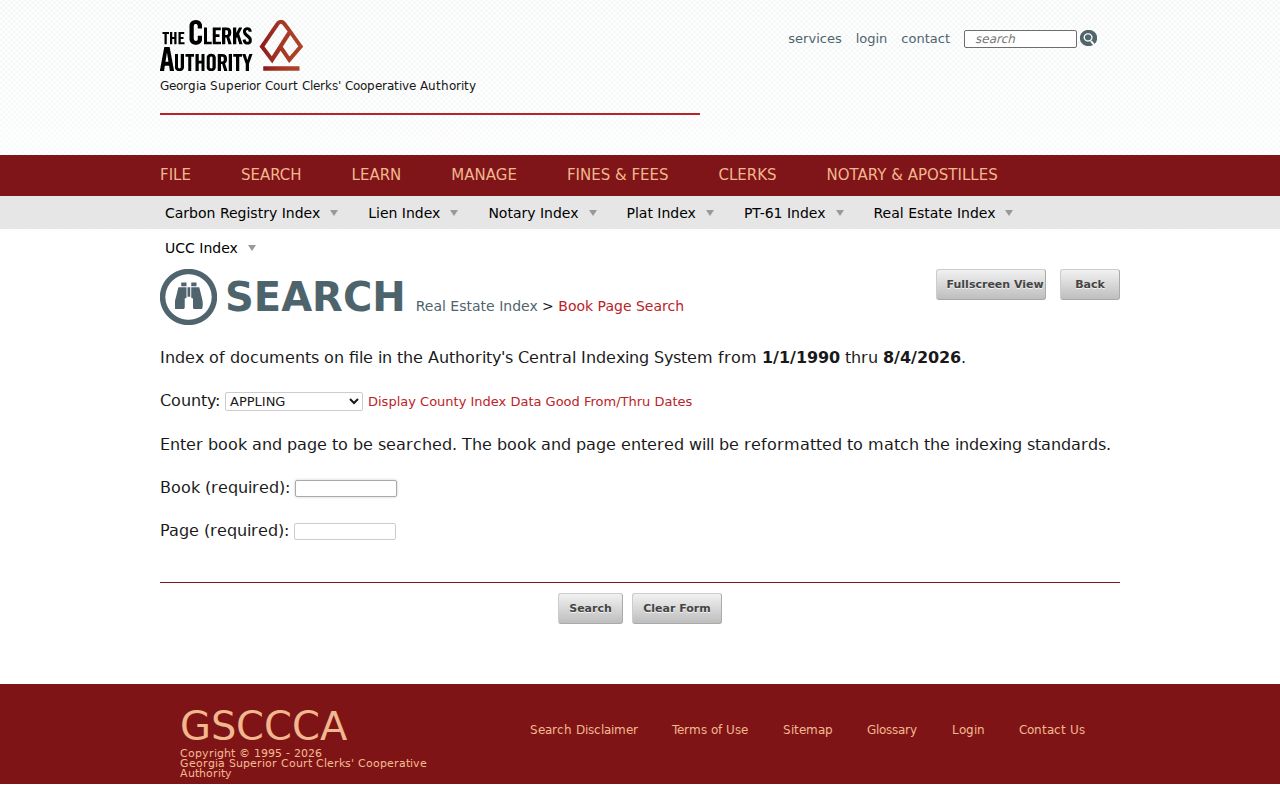
This narrow lookup earns its keep late. Reach for it only after a deed, plat, archive note, or legal advertisement supplies a citation.
Keep Jones County Parcel Formats Beside the Former Owners
Jones County records show parcel strings like J03-00-009, J03 00 008, J59A 00 080, J45C00 093, and J51 00 224. No official key decodes every letter, suffix, or zero. Treat each version as a literal identifier. Try punctuation variants freely, but never strip letters or leading zeroes. A parcel can also carry a land-lot and district description, a subdivision lot, and a current street address. The strongest match brings all of them into agreement. An old index may omit the current parcel number. Search the prior owner's name and the durable land description. Never force the modern number backward. Note: Mailing city, situs address, and legal description are distinct fields, and each may point to the same tract in a different way.
Earlier Jones County Former Owners Beyond the Online Index
Jones County dates to 1807. Chains from that era lean on Clinton, district, land-lot, road, ferry, plantation, and railroad wording. Gray took over as county seat in 1905 and was chartered in 1911. So when an old entry shifts from Clinton language to a Gray address, geography and record practice usually explain it. That is not the same as broken ownership.
For anything before 1980, start with the Clerk's old deed-room indexes and books. Then move to the Georgia Archives catalog and its microfilm. UGA's Cawthon collection is unusually rich. Its finding aid covers deeds from 1814 onward. It also holds early Jones and Clinton land records, surveys from 1869 and 1873, tax digests, maps, and 1938 aerial photographs. The collection lists no online items, so plan on reading-room help.
Library, genealogical, cemetery, and newspaper sources can supply spellings, family names, and tract terms. Treat them as context until a deed, estate record, or court order confirms the transfer.
Do Not Turn a Jones County Scan Gap Into a Records-Loss Story
Jones County has no documented courthouse fire or flood in its official history. There is no other record-loss event either. A missing web image usually means something ordinary. The document may be unscanned, mis-indexed, restricted, or held only by the Clerk. Some historical GSCCCA entries were even reconstructed from images.
When a link fails, write down the county. Also note the party name, instrument type, date, book and page, and legal description. Then call or visit the Real Estate Division at 110 South Jefferson Street in Gray. You can also send a focused request. The office is open Monday through Friday, 8:00 a.m. to 5:00 p.m. The main number is 478-986-6671.
Estate transfers can also break a tidy deed sequence. Search deeds under executor or administrator names, Probate Court files, and related court orders. Do not assume the property changed hands without a record.
How Far Back Jones County Former-Owner Records Reach
The county's published table sets the online real-estate index marker at January 1, 1980 and the plat marker at January 1, 1963. Those dates describe online coverage only. They say nothing about when Jones land records began. Earlier owners remain a deed-room and archive task. Always note the current good-through date too, because the index can lag the Clerk by several days.
The backward chain ends only where the proof ends. A tax digest can place a name with land in a given year. A newspaper notice can surface a book and page citation. Neither one replaces the transfer instrument itself. When rights, inheritance, or a pending deal turn on the answer, a certified copy or a title professional may be necessary.
Coverage limit. The online Jones County index begins at its 1980 marker. Continue older former-owner work in Clerk deed books, microfilm, and archival collections.
Former-owner records serve house history, estate work, and purchase diligence. They must never be used to stalk, target, or harass a living person.